

Çanakkale Onsekiz Mart Üniversitesi
Çocuk Eğitimi Uygulama ve Araştırma Merkezi

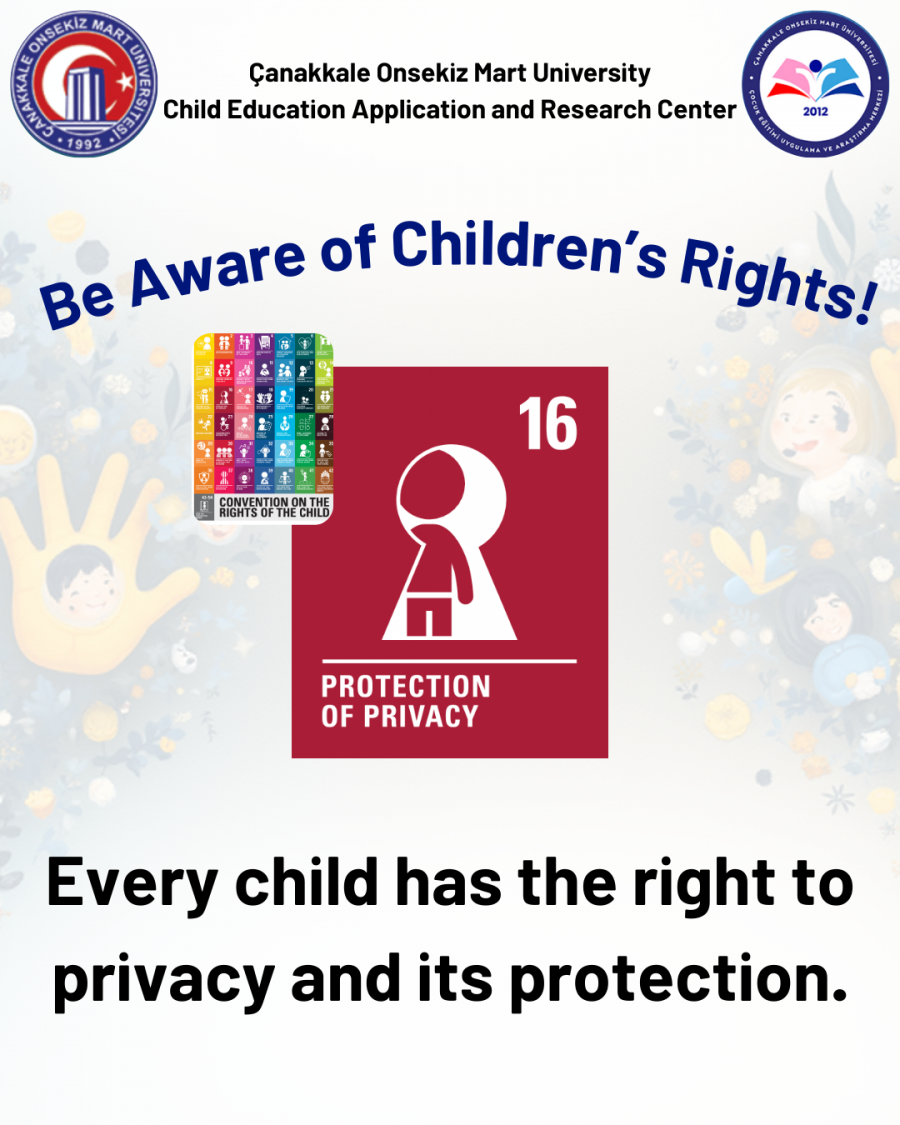
Article 16 of the United Nations Convention on the Rights of the Child protects every child’s right to privacy. This right ensures that no child is subjected to arbitrary or unlawful interference with their family life, home, correspondence, or personal reputation (United Nations Human Rights Office of the High Commissioner, 2018). Privacy is not merely about keeping information secret; it is fundamental for the child’s ability to form an identity, process emotions, develop independent thoughts, and create a personal space in which they can grow safely (Whalen, 2022). For this reason, privacy is considered an essential element of children’s healthy and confident development.
In the digital age, the scope of privacy has expanded significantly. Children now require protection not only in the physical world but also online. Social media, online games, learning platforms, and smart devices often collect children’s photos, locations, communication patterns, and behavioral data automatically (Arnetta et al., 2023). This reality requires a contemporary interpretation of Article 16 that includes digital environments. Research shows that children’s digital footprints are often created without their knowledge and can later be used for advertising, profiling, or other commercial purposes (Briazu et al., 2021; Conti et al., 2024; Gatto et al., 2024; Walrave et al., 2022).
Parent-driven sharing, commonly known as sharenting, has become one of the most discussed privacy issues today. Although parents often share pictures of their children with good intentions, these posts can have long-term consequences on the child’s digital identity (UNICEF, 2024). Sharing images that the child might not want online can lead to embarrassment later in life or even malicious misuse. Experts emphasize that parents should ask the child for their opinion, seek consent, and teach digital privacy awareness before posting any content (Warrington & Larkins, 2019). Ignoring children’s views may undermine both their privacy rights and the development of personal boundaries (Conti et al., 2024; Kılıç et al., 2024; Walrave et al., 2022).
Some children need special protection. Those living in institutional care, shelters, or alternative care settings are often more vulnerable to privacy breaches. Studies show that these children may experience searches of personal belongings, monitoring of communication, or restrictions in digital contact (Ayalew et al., 2024; Lubaale, 2025). For this reason, Article 16 places an enhanced duty on States to ensure that these children’s private life is respected and protected.
The right to privacy is not absolute; it must be balanced with the child’s safety and the rights of others. However, experts emphasize that the purpose is not to monitor children excessively but to empower them (Save the Children, 2023). Adults should support children in recognizing digital risks, encourage open communication, and help them gain the skills needed for safe digital participation. Ensuring digital safety requires both protection and the gradual development of autonomy (Whalen, 2022).
In essence, privacy allows children to be visible without being watched, supported without being controlled, and protected without losing their independence. Every child deserves to be safeguarded from unwanted exposure, uncontrolled data sharing, misuse of personal information, and attacks on their dignity. Protecting privacy is essential for children to develop confidence, self-awareness, and a strong, stable sense of identity. Creating a society where children have their own safe space, both offline and online, is a collective responsibility shared by families, institutions, digital platforms, and governments.
References
Arnetta, L. D., Fathyasani, G. A., & Suryawijaya, T. (2023). Children’s Privacy in the Digital World: A Review of the Law on the Use of Technology Child. https://doi.org/10.20944/preprints202311.0031.v1
Ayalew, Y. E., Verdoodt, V., & Lievens, E. (2024). General Comment No. 25 on Children’s Rights in Relation to the Digital Environment: Implications for Children’s Right to Privacy and Data Protection in Africa. Human Rights Law Review,24(3). https://doi.org/10.1093/hrlr/ngae018
Briazu, R. A., Floccia, C., & Hanoch, Y. (2021). Facebook sharenting in mothers of young children: The risks are worth it but only for some. Technology, Mind, and Behavior, 2(4). https://doi.org/10.1037/tmb0000051
Conti, M. G., Del Parco, F., Pulcinelli, F. M., Mancino, E., Petrarca, L., Nenna, R., Di Mattia, G., Matera, L., La Regina, D. P., Bonci, E., Caruso, C., & Midulla, F. (2024). Sharenting: characteristics and awareness of parents publishing sensitive content of their children on online platforms. Italian Journal of Pediatrics, 50(1), 135. https://doi.org/10.1186/s13052-024-01704-y
Gatto, A., Corsello, A., & Ferrara, P. (2024). Sharenting: hidden pitfalls of a new increasing trend– suggestions on an appropriate use of social media. In Italian Journal of Pediatrics (Vol. 50, Issue 1). https://doi.org/10.1186/s13052-024-01584-2
Kılıç, S., Orhan Kılıç, B., Gül Ateş, E., Çullas Ilarslan, N. E., Konuksever, D., & Ulukol, B. (2024). Exploring the Depths of Sharenting: Unveiling the Impact of Sociodemographic Factors and Internet Addiction. Journal of Pediatric Health Care, 38(5), 643–650. https://doi.org/10.1016/j.pedhc.2024.05.011
Lubaale, E. C. (2025). Anonymity in judgments: safeguarding children’s rights in Uganda and the Global South. International Journal of Children’s Rights.
Save the Children. (n.d.). UNCRC Article 16: children’s rights to privacy. https://www.savethechildren.org.au/about-us/save-the-childrens-charity-work/uncrc-article-16-childrens-rights-to-privacy
UNICEF. (2024). Paylaşan ana-babalık (“sharenting”) hakkında bilmeniz gerekenler. https://www.unicef.org/turkiye/hikayeler/paylaşan-ana-babalık-sharenting-hakkında-bilmeniz-gerekenler
United Nations Human Rights Office of the High Commissioner. (2018). Article 16. The right to Protection of Privacy, Family, Home, Correspondence, Honour, and Reputation. https://www.ohchr.org/sites/default/files/Documents/Issues/Privacy/SR_Privacy/privacy-child/Other-Stakeholders/15-Tobin-J-and-Field-SM-Article-16.pdf
Walrave, M., Verswijvel, K., Ouvrein, G., Staes, L., Hallam, L., & Hardies, K. (2022). The Limits of Sharenting: Exploring Parents’ and Adolescents’ Sharenting Boundaries Through the Lens of Communication Privacy Management Theory. Frontiers in Education, 7. https://doi.org/10.3389/feduc.2022.803393
Warrington, C., & Larkins, C. (2019). Children at the centre of safety: challenging the false juxtaposition of protection and participation. Journal of Children’s Services, 14(3), 133–142. https://doi.org/10.1108/JCS-09-2019-055Whalen, C. (2022). Article 16: The Right to Protection of Privacy (pp. 93–102). https://doi.org/10.1007/978-3-030-84647-3_11